
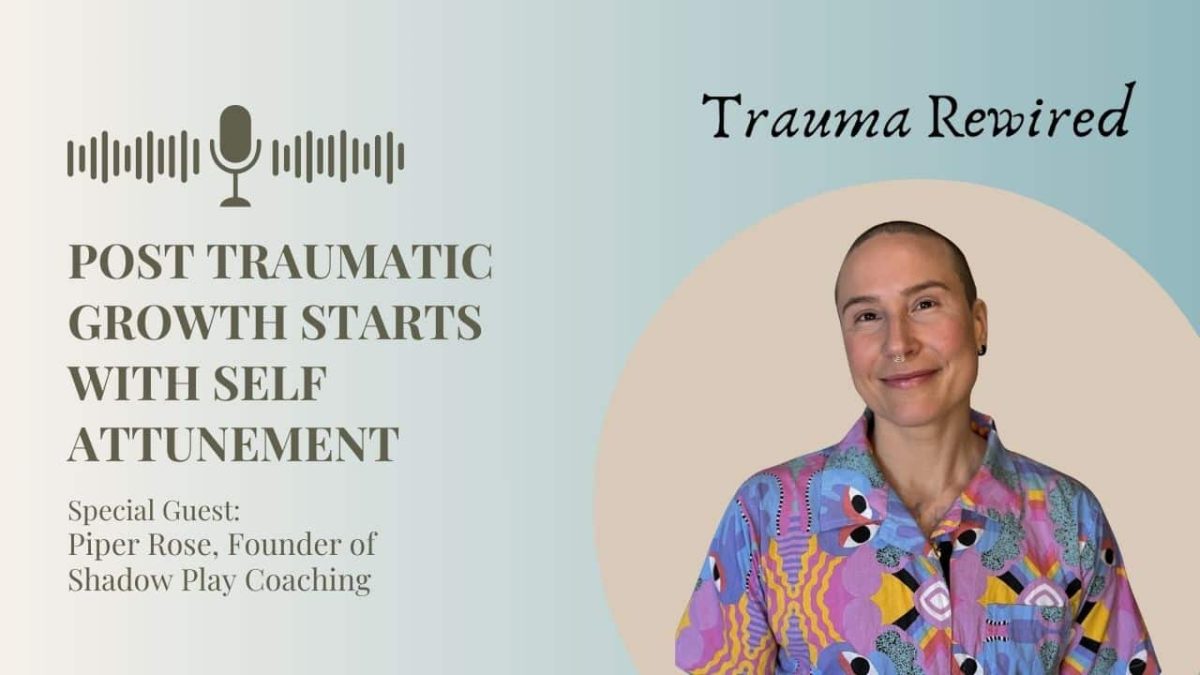
What if the places we have been hurt most, our relationships, can also become the places where we grow? In this episode, we explore relational healing as a powerful driver of post-traumatic growth. Together, we unpack why safe connection can feel threatening after complex trauma, how protective patterns like fight, freeze, and fawn are intelligent adaptations (not personal failures), and why “capacity” is less about willpower and more about what your nervous system can hold in real time. You will hear how micro-moments of self attunement can reduce hypervigilance, build trust from the inside out, and turn insight into embodied change.
In this episode of Trauma Rewired, co-hosts Elisabeth Kristof (founder of BrainBased.com and the Neurosomatic Intelligence Coaching Certification) and Jennifer Wallace (Neurosomatic Psychedelic Preparation and Integration Guide) are joined by Piper Rose, a Neurosomatic Relationship Coach, founder of Shadowplay Coaching, and Director of Operations and Continuing Education at NSI. Piper shares an honest, grounded look at how co-regulation, repair, and “the burden of love” can become a training ground for deeper intimacy, resilience, and self compassion.
Timestamps:
- 00:00 Intro: Why healing is relational, not just individual
- 03:30 Meet Piper Rose and what “Neurosomatic Relationship Coaching” means
- 08:20 Trauma, attachment wounding, and protective F responses in relationships
- 16:10 Reframing patterns as adaptations, not defects, and finding the “gifts” inside them
- 22:40 Neuroscience of connection: co-regulation, threat prediction, and updating the model
- 31:30 Why safe relationships can trigger fear, emotional flashbacks, and vulnerability
- 41:10 Self attunement, needs, and practicing repair in micro-moments
- 49:20 Community, nature, and animals as lower-risk pathways to relational practice
- 56:30 Closing reflections: building trust, capacity, and support beyond one relationship
Key Takeaways:
- Relational patterns like fight, freeze, and fawn are often strategic survival adaptations, not signs you are “broken.”
- Safe connection can feel dangerous when your nervous system is trained to predict harm in intimacy.
- “Capacity” is not just skill or knowledge. It is whether your body can access those skills under pressure.
- Self attunement, like responding to thirst, overwhelm, or startle, builds a foundation for secure internal attachment and clearer boundaries.
- You do not have to do relational healing alone. Support teams, community, nature, and animals can provide safe enough co-regulation while you build trust.
Resources Mentioned:
- Free live 90-minute workshop: Neurosomatic.com/Integration
- NSI Community: Neurosomatic.com
- BrainBased: BrainBased.com
- Sacred Synapse: an educational YouTube channel founded by Jennifer Wallace that explores nervous system regulation, applied neuroscience, consciousness, and psychedelic preparation and integration through Neurosomatic Intelligence.
- Wayfinder Journal: Track nervous system patterns and support preparation and integration through Neurosomatic Intelligence.
- FREE 1 Year Supply of Vitamin D + 5 Travel Packs from Athletic Greens when you use my exclusive offer: https://www.drinkag1.com/rewired
- Cozolino, L. J. (2014). The Neuroscience of Human Relationships: Attachment and the Developing Social Brain (2nd ed.). W. W. Norton & Company
Call to Action:
Subscribe on your favorite audio platform or join us on YouTube!
For a deeper understanding of integration, join our free live 90-minute Integration Workshop on February 11, 2026, at 12 PM CT. This experiential training covers how the nervous system processes change and how to integrate it effectively.
You can also continue learning tools for nervous system regulation and post-traumatic growth at RewireTrial.com