
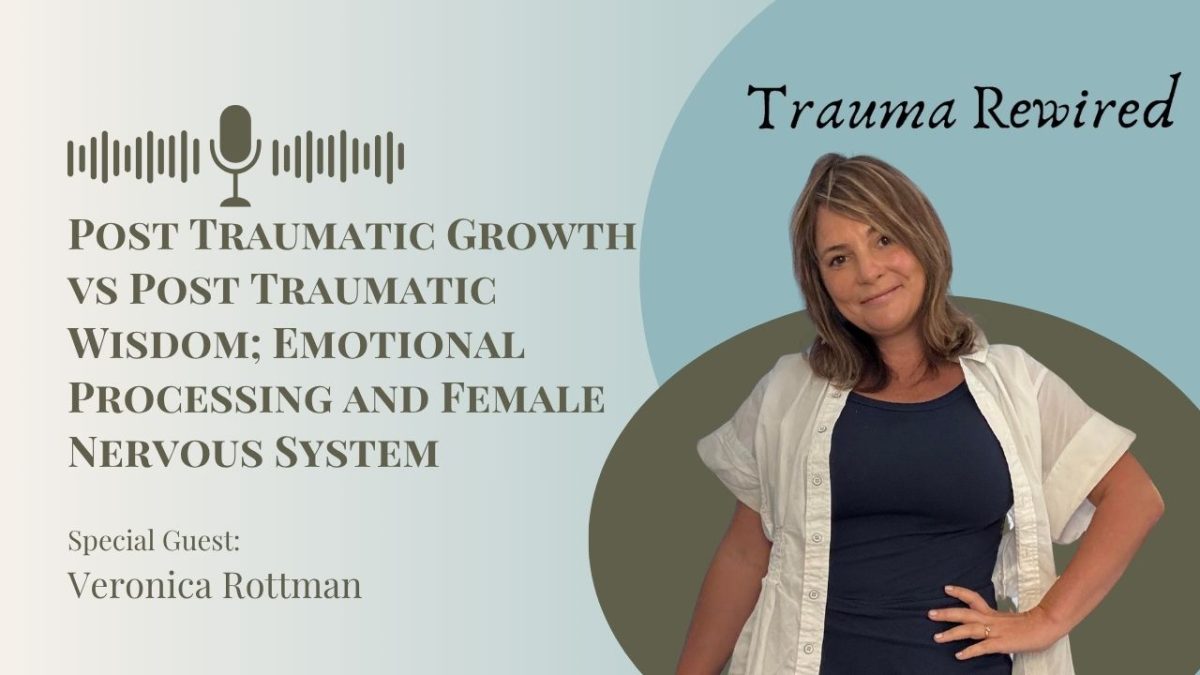
Functional healing isn’t about bouncing back, it’s about becoming more whole. In this episode of Trauma Rewired, Elisabeth Kristof and Jennifer Wallace are joined by somatic expert Veronica Rottman, founder of Soma School, to explore what happens when post-traumatic growth deepens into post-traumatic wisdom.
Together, we unpack how healing often involves grief, identity shifts, and surrender, not just resilience and strength. You’ll hear how emotions are constructed in the body, why dissociation and fawning are intelligent survival responses, and how safety is rebuilt through slow, titrated somatic experiences. We discuss how cultural narratives about “getting stronger” can overlook the body’s need for modulation, rest, and relational repair.
You’ll learn how capacity building is nonlinear, why co-regulation and oxytocin-based safety cues matter, and how tending to wounds rather than fixing them can transform pain into embodied wisdom.
Join us for a workshop, taking a deeper dive into Hormones, Stress and the Female Nervous System, combining applied neuroscience and somatics to support female cycles: https://neurosomaticintelligence.com/female-nervous-system-workshop/
Timestamps:
- 00:00 Welcome and framing: growth vs. wisdom
- 05:30 Emotions as predictions and survival patterning
- 14:00 Dissociation, boundaries, and identity shifts
- 22:30 Somatic titration, oxytocin, and co-regulation practices
- 31:00 Capacity, achievement, and health trade-offs
- 39:30 Reframing fawn and freeze as intelligent responses
- 47:00 Cyclical needs, rest, and redefining growth
- 54:00 Integration, tending, and systemic context
- 59:00 Takeaways and next steps
Key Takeaways:
- Post-traumatic wisdom includes grief, ambiguity, and letting identities evolve, not only resilience.
- Emotions are constructed from interoception and predictions; safety cues can update those predictions.
- Small, consistent somatic doses help the system perceive more safety without overwhelm.
- Fawn and freeze are adaptive; meeting them with curiosity reduces shame and supports change.
- Capacity building is relational; co-regulation and oxytocin-supportive practices can expand what feels possible.
Listen across all podcast platforms
Transcript available on Apple Podcasts
Resources Mentioned:
- Soma School – founded by Veronica Rottman
- Neurosomatic Intelligence Coaching Certification
- Brain Based
- The Highly Sensitive Person by Elaine Aron (via Alanis Morissette interview)
- Peter Levine on Somatic Titration and Safety
- Dr. Stephen Porges and the Polyvagal Perspective
- Lisa Feldman Barrett – Theory of constructed emotion
- Vincent Felitti – The ACE (Adverse Childhood Experiences) Study
- Raja Selvam – Integral Somatic Psychology
Call to Action:
If this episode offered you a new perspective on healing—or gave language to something you’ve felt but couldn’t name—share it with someone who needs to hear it. And don’t forget to subscribe on your favorite audio platform or tap the bell on YouTube so you never miss an episode.
If you’ve ever noticed your focus, energy, or emotions shift throughout your cycle, this next workshop will help you understand why. On November 13th at 12pm Central, Elisabeth Kristof and Veronica Rottman will explore how your hormones interact with your nervous system—and how somatic tools can support you through every phase.
Join live or catch the replay at https://neurosomaticintelligence.com/female-nervous-system-workshop/