
The wound between women is not just interpersonal. It is neurobiological, historical, and deeply rooted in systems that were designed to divide us.
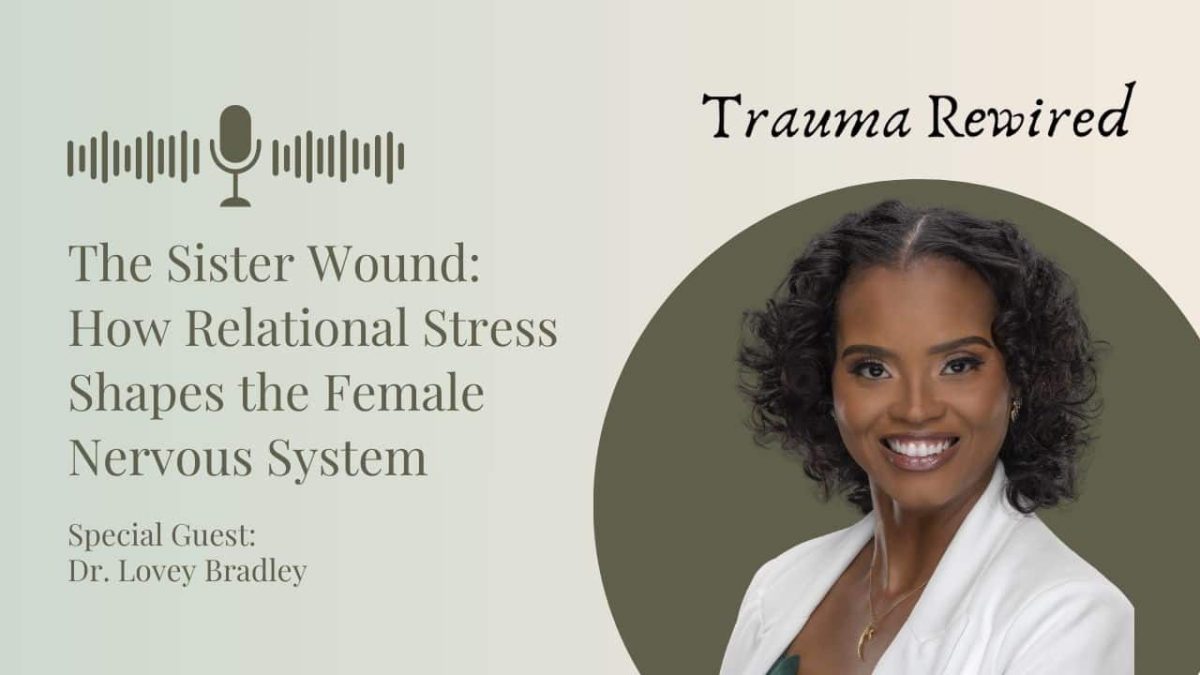
In this episode, we are joined by Dr. Lovey Bradley, Msc.D., NSI certified practitioner, BrainBased facilitator, and facilitator of the NSI BIPOC Affinity Group, whose work sits at the intersection of female hormone health, nervous system regulation, and somatic approaches to trauma. Together, we go deep on one of the most underexplored dimensions of collective healing: the feminine wound, and specifically the racial fracture at its root.
Lovey shares her own experience of dissociation in a predominantly white healing space during her NCAI certification, and what that revealed about epigenetic nervous system patterns that have nothing to do with individual will and everything to do with what our bodies have inherited and learned to expect. We reflect honestly on our own experiences, including what it takes for white bodied women to pause, stop fixing, and actually listen without collapsing into shame or urgency.
The conversation also traces the science behind why relational stress hits the female nervous system so hard, why oxytocin can amplify threat as much as it buffers it when relationships are unsafe, and how chronic cortisol dysregulation suppresses progesterone and drives the health outcomes so many women are navigating.Topic Include:
- Why the feminine wound cannot be fully healed without naming its racial roots
- How the nervous system adapts to chronic relational threat in female coded spaces
- What social baseline theory tells us about why disconnection between women is a physiological load, not just an emotional one
- How early experiences of exclusion, relational aggression, and peer victimization become nervous system prediction patterns in adulthood
- Why oxytocin amplifies relational stress when social environments are unsafe
- How high cortisol suppresses progesterone and drives inflammation, infertility, and hormonal dysregulation
- What it looks like for white bodied women to stay present without defaulting to shame, urgency, or over-repair
- Why healing within cultures must precede healing across them
- What a real path forward looks like, starting at the individual level
Chapters
0:00 – Why Racial Trauma Is the Root We Are Not Talking About
1:05 – Welcome: The Feminine Wound Through a Nervous System Lens
3:48 – Introducing Dr. Lovey Bradley and Why This Conversation Matters
7:00 – How the Sister Wound Shows Up in Friendships, Workplaces, and Healing Spaces
10:21 – Dr. Lovey’s Personal Story: Dissociating in a Predominantly White Healing Space
17:11 – Social Baseline Theory and the Neurobiology of Relational Disconnection
24:54 – The Historical Root: White Women, Racial Hierarchy, and the Fractured Sisterhood
27:26 – What It Takes for White Bodied Women to Listen Without Collapsing
34:14 – Colorism, Division Within Cultures, and Where Trust Has to Begin
43:08 – Early Developmental Roots: How Relational Threat Shapes the Nervous System
46:52 – Oxytocin, Cortisol, Progesterone, and the Female Hormone Connection
49:56 – A Path Forward: Building Trust One Relationship at a Time
Ways to Engage with Neurosomatics:
- Neurosomatic Intelligence is now enrolling : https://neurosomaticintelligence.com/nsi-certification
- Join us for a two week trial of neurosomatic practices at rewiretrial.com
- Free BrainBased neurosomatic workshop for entrepreneurs at rewirecapacity.com
- Sacred Synapse: an educational YouTube channel founded by Jennifer Wallace that explores nervous system regulation, applied neuroscience, consciousness, and psychedelic preparation and integration through Neurosomatic Intelligence.
- Wayfinder Journal: Track nervous system patterns and support preparation and integration through Neurosomatic Intelligence.
- Learn to work with Boundaries at the level of the body and nervous system at https://www.boundaryrewire.com
Resources that inform this episode:
Coan, James A., Hillary S. Schaefer, and Richard J. Davidson. “Lending a Hand: Social Regulation of the Neural Response to Threat.” Psychological Science, vol. 17, no. 12, 2006, pp. 1032–1039.
Crick, Nicki R., and Jennifer K. Grotpeter. “Relational Aggression, Gender, and Social-Psychological Adjustment.” Child Development, vol. 66, no. 3, 1995, pp. 710–722.
Holt-Lunstad, Julianne, Timothy B. Smith, and J. Bradley Layton. “Social Relationships and Mortality Risk: A Meta-Analytic Review.” PLOS Medicine, vol. 7, no. 7, 2010, e1000316.
Miller, Jean Baker. Toward a New Psychology of Women. Beacon Press, 1976. Wellesley Centers for Women ed., 2012.
Prinstein, Mitchell J., et al. “Peer Victimization, Friendship, and the Stress Response.” Development and Psychopathology, vol. 17, no. 4, 2005, pp. 1017–1038.
Rimé, Bernard. “Emotion Elicits the Social Sharing of Emotion: Theory and Empirical Review.” Emotion Review, vol. 1, no. 1, 2009, pp. 60–85.
Shamay-Tsoory, Simone G., and Ahmad Abu-Akel. “The Social Salience Hypothesis of Oxytocin.” Biological Psychiatry, vol. 79, no. 3, 2016, pp. 194–202.
Taylor, Shelley E., et al. “Biobehavioral Responses to Stress in Females: Tend-and-Befriend, Not Fight-or-Flight.” Psychological Review, vol. 107, no. 3, 2000, pp. 411–429.
Taylor, Shelley E. “Tend and Befriend: Biobehavioral Bases of Affiliation under Stress.” Current Directions in Psychological Science, vol. 15, no. 6, 2006, pp. 273–277.
Tedeschi, Richard G., and Lawrence G. Calhoun. “Posttraumatic Growth: Conceptual Foundations and Empirical Evidence.” Psychological Inquiry, vol. 15, no. 1, 2004, pp. 1–18.
Uchino, Bert N. “Social Support and Health: A Review of Physiological Processes Potentially Underlying Links to Disease Outcomes.” Journal of Behavioral Medicine, vol. 29, no. 4, 2006, pp. 377–387.