
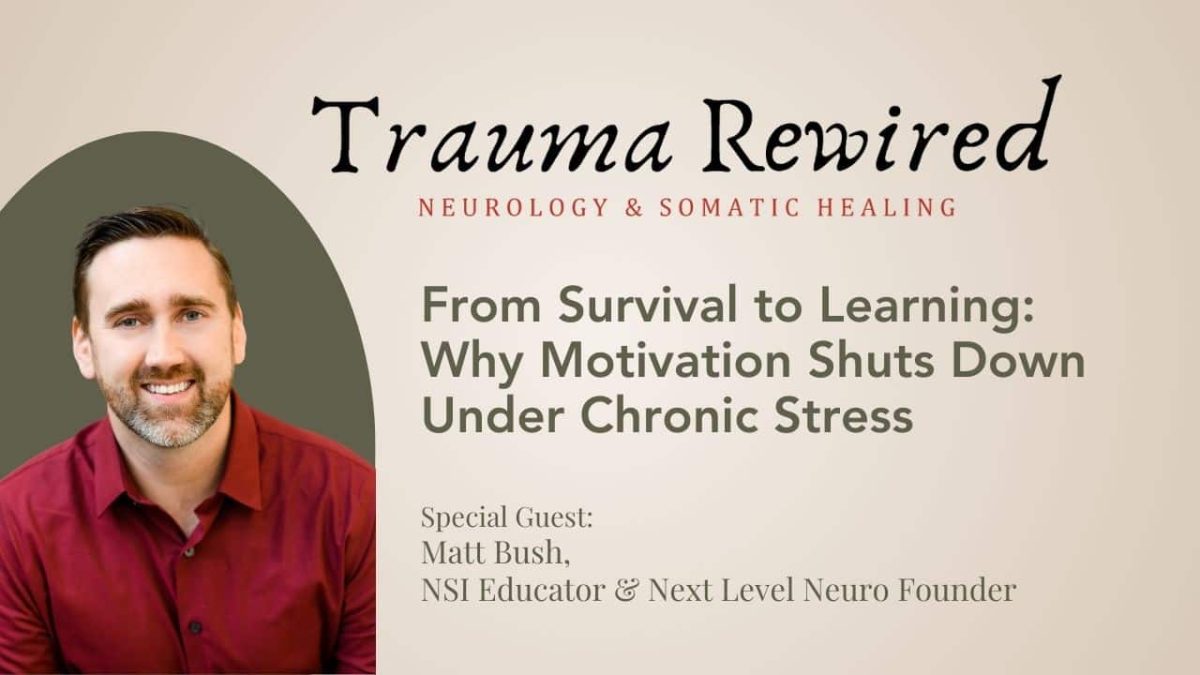
Have you ever shared an idea, been met with silence, and felt your body instantly brace like something was wrong? Or walked to your car and suddenly felt flooded by an old fear, even though nothing “new” happened? In this episode, we explore how trauma and chronic stress can shift the brain from learning mode into survival mode, shaping what we remember, how we recall it, and how safe it feels to stay curious. You will hear why memory is not a perfect recording, how present-day state influences recall, and how the nervous system can tag even subtle cues, like a pause or a tone, as danger when past experiences taught your body that silence equals disconnection.
In this episode of Trauma Rewired, we are joined by Matt Bush, founder of Next Level Neuro and lead educator in the NSI certification. Together, we unpack explicit vs. implicit memory, how the hippocampus, amygdala, and prefrontal cortex influence recall and learning, and how regulation, sensory inputs, and repetition can support integration and post-traumatic growth.
Timestamps:
- 00:00 A real-life trigger: when silence, social cues, or context flips the body into survival
- 08:00 Memory basics: explicit vs. implicit, plus episodic, semantic, emotional, and procedural memory
- 16:00 Why memory is reconstructive: state, prediction, and sensory integration shape recall
- 24:00 Trauma + memory: hippocampus, amygdala, and why facts fade while sensations intensify
- 33:00 Learning after trauma: attention as a nervous system state, and why willpower is not the lever
- 42:00 Memory reconsolidation and “windows” for updating threat charge with regulation
- 55:00 Psychedelics, preparation, and nervous system training: capacity, safety, and integration
- 1:07:00 Motivation, dopamine pathways, and rebuilding curiosity through safe repetition
- 1:18:00 Closing reframes: contraction and expansion, neurodiversity, and reducing sensory “noise”
Key Takeaways:
- Trauma can disrupt how memories are stored and recalled, especially under high stress, without it being a personal failure.
- Memory is reconstructive, and your current nervous system state can change how both positive and negative memories feel.
- Learning is embodied: attention, curiosity, and motivation depend on safety signals in the body, not just mindset.
- Regulation plus recall can create opportunities to update threat charge and build new predictions over time.
- Repetition is not just practice. It is consistent exposure to safety while doing something new.
Resources Mentioned:
- Free live 90-minute workshop
- NSI Community
- BrainBased
- Next Level Neuro
- Sacred Synapse: an educational YouTube channel founded by Jennifer Wallace that explores nervous system regulation, applied neuroscience, consciousness, and psychedelic preparation and integration through Neurosomatic Intelligence.
- Wayfinder Journal Track nervous system patterns and support preparation and integration through Neurosomatic Intelligence.
- FREE 1 Year Supply of Vitamin D + 5 Travel Packs from Athletic Greens when you use my exclusive offer
Call to Action:
Subscribe on your favorite audio platform or join us on YouTube!
For a deeper understanding of integration, join our free live 90-minute Integration Workshop on February 11, 2026, at 12 PM CT. This experiential training covers how the nervous system processes change and how to integrate it effectively.
You can also continue learning tools for nervous system regulation and post-traumatic growth at www.rewiretrial.com